“I was born normal with Apgar score 10/10 at 1 and 5 mins but my normal life lasted less than 5 days...”
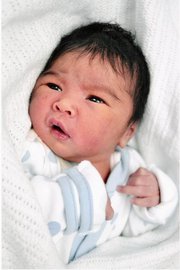
Sharing the story of our dearest son who became profoundly disabled as he didn't receive a simple treatment in time as a baby but always accepts the very many pains that he endures in his everyday life with big charming smiles, the smiles that give his parents the vital strength to keep going. We hope that these information serve to:
- Providing information to to-be parents
- Reminding the many health professionals the serious danger posed by Jaundice
- Sharing our experiences with those unfortunate parents out there
Chapters of Life
- Pregnancy - A period of dedication
- Birth - A special day for the parents
- Home - The moment of pride and jubilation for the family
- Hospital: Stage I - ICU, the moment the world turned upside down
- Hospital: Stage II - SCU, hope and prayer
- Home - A Second chance of life with a curtailed Splendour!
- Chief Executive's response, we just hope the hospital doesn't break any more hearts!
- What went wrong! - Parents please beware!
- Life! - Has to move on!
Home - A Second chance of life with a curtailed Splendour!
Our emotional well beings were far from normal with teary eyes and heavy hearts but we were so happy that our son was still with us. His presence gave a new breeze of life to all his belongings in the house which looked so empty and dull while he was bravely confronting all the adversaries bare chested in the hospital! We also were happy to see the innocent smiles on the faces of his brothers who were able to hold him this time around and were proudly doing so taking turns, we could only try to hide our emotions and the lumps in the throats smiling back to the boys, while we were praying to God in the back of our minds to give our son another chance in life!
As a baby he was quite hungry, in spite of having a small visible sign of lost of coordination, he was sucking bottle milk very well. Unfortunately, by the time he was able to suck milk in the hospital ward and subsequent discharge his mum's flow of breast milk had been significantly dried due to reasons such as mental, physical and most importantly he had not been sucking them for quite some days. He was gaining weight and growing quite quickly with normal morphological appearances, he was doing very well in the early stages. The following are some photographs from those days.
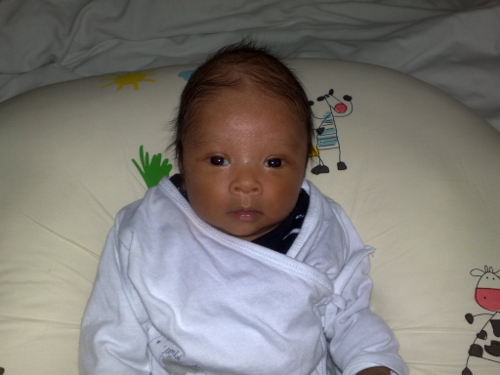 5 days after coming back home, 12th Jan 2011!
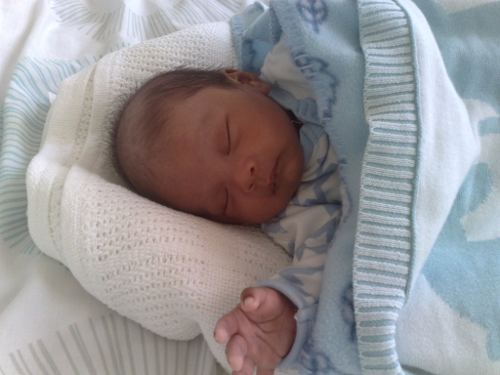 21st Jan 2011!
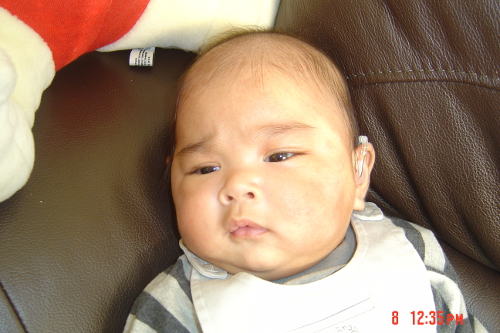 8th Mar 2011!
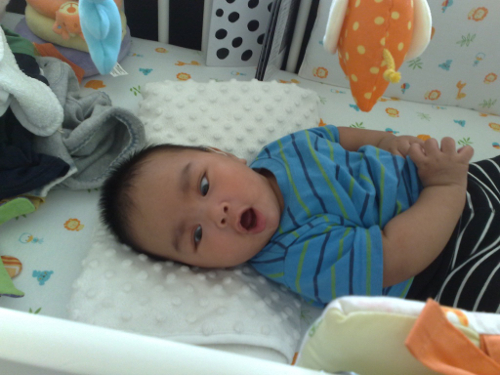 2nd May 2011!
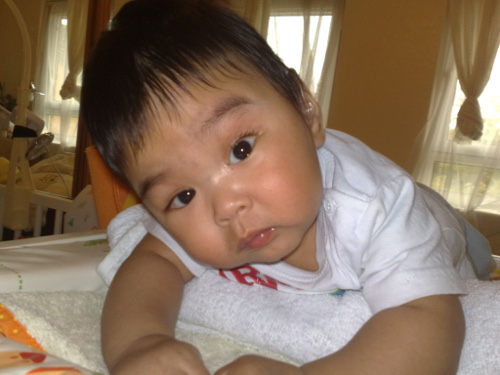 20th June 2011, 6 months and 4 days old!
In this early stage the most visible and significant issues were:
- Hearing loss: the second and subsequent tests confirmed that he now lost hearing and diagnosed with severe to profound Sensorineural Hearing loss
- Eye-Rolling/Sun-Setting: where the eyes just rolled making only the whites of the eyes (Sclera) visible when he was picked up or put down
- His physical appearance: most of the hairs fallen and developed a squeaking voice; the neurologist probably had seen some stiffening tone by then but we as laymen didn't remember seeing a significant change in the tone just yet
By this time he was diagnosed with a myriad of issues. He was referred to the Ophthalmology Department of the hospital and was seen when he was about 5 months old to investigate the eye-rolling problem and possible effects to his vision. The following is report of the visit, not only it got some of the issues diagnosed but I also found the wordings of the letter interesting, it seemed showing that the symptoms were new to the consultant in charge!
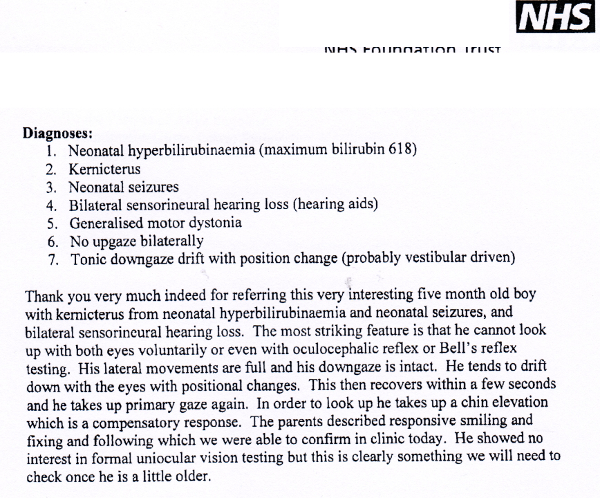
The Ophthalmology department later referred him to GOSH when he was about 6 months old where we were told that the vision was near normal.
Three stood out conditions!
The underlying issues started surfacing one by one. My son was suspected to have seizure while he was in the ICU even though it was never caught on the EEG monitor and recordings. So when he was discharged from the hospital he was prescribed an anti-convulsion medication (Phenobarbital) but it was discontinued on the pediatrician's advice after a couple of months as it was not assumed to be an issue any more.
Every day had been and still is a challenge! But in June 2011 we noticed something strange with our son. One day we noticed that he would twitched his right eye, blankly staring on something and momentarily stopping his breathing. The whole thing would last for about 20-30 seconds, after that he would sweat a bit on his forehead. We couldn't say if this was the first day it happened or if some of such previous episodes had been lost among all the other issues, especially because these episodes used to be so brief. We were then alert and were looking out for it. That day it happened three times, hours apart. Then it stopped, didn't happened again. After a couple of weeks we again noticed the same, 4/5 times the same day. It stopped again until after 14 days that is. So it was happening in clusters at 14 days of regular intervals, we reported this to his pediatrician who suspected it to be a seizure. She referred my son to a neurologist in Oxford Hospital. After some time we had an appointment to see the neurologist who also suspected it to be seizure. He gave us a date to come back in October for 72 hours Ambulatory EEG to record seizure activity. The date given was in the middle of the 14 day period of two possible occurrences so I warned that we might not record anything but we were advised to go ahead and we did. The electrodes of the EEG equipment were fitted to his head and we came home to start the 72 hours journey, which was not by any means an easy one to try to keep all electrodes intact as well as trying to cheer him up. The following is a photo taken on Oct 13, 2011 attached to the EEG equipment, he was just before 11 months old.
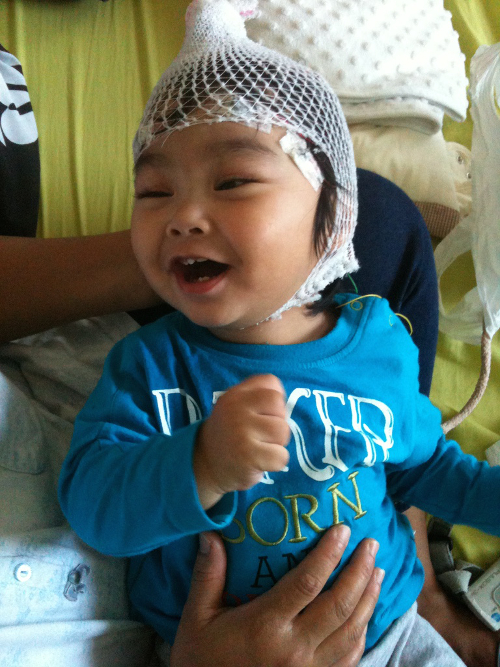
As I suspected, the three days of hard work went in vain, no seizure activity was observed in the recordings according to the report that followed. I tried to take short video clips of the episodes when it happened in the next cycle but I was unsuccessful as the episodes were so short and were hours apart. I again tried in the next cycle. That day after the first episode I put him down on a mat and was waiting with the camera set up. I was successful in taking a clip but I really felt guilty afterwards, that episode was really different from all the ones he had before, was stronger in nature and longer producing a sound like yee-yee-yee! I felt like he was scared of something as well, perhaps it might because of me touching him from behind with the camera in the other hand or perhaps he was tired! Nevertheless, I sent the clip to the team that included my son's neurologist and pediatrician. Subsequently he was given a seizure medication, Carbamazepine, in Dec 2011 and since then it never came back, or at least as far as we could notice. I don't know if seizures could increase the existing brain damage or enhance its progression so I felt this was an important phase in my son's development.
As mentioned earlier, after a series of hearing tests the audiology department diagnosed our son with severe to profound Sensorineural hearing loss. He started wearing hearing aids but it was thought that it was not helping him and he was referred for Cochlear implant assessment and commenced the same shortly. I later found that the majority of the hearing loss caused by Jaundice / Hyperbilirubinemia were Auditory Neuropathy rather than Sensorineural. I also read on the Internet that children with Auditory Neuropathy got a chance to regain the lost hearing! Subsequently I got the opportunity to speak to the parents of a boy from the US who regained hearing after 6 months of diagnosing with Auditory Neuropathy hearing loss, through an Internet group. After that we prayed and hoped for our son even though he was diagnosed with the Sensorineural rather then Auditory Neuropathy hearing loss! After the assessment process the Cochlear Implant Centre advised to have cochlear implants on both ears. It was really a tough decision for us as we knew that it was an irreversible process and we still were hoping in case just in case! On the other hand we didn't like to deprive our son's hearing any longer as it was so crucial to his already delayed development. So we accepted the advice of the cochlear implant experts and went ahead for bilateral cochlear implants, 2nd Jul 2012.
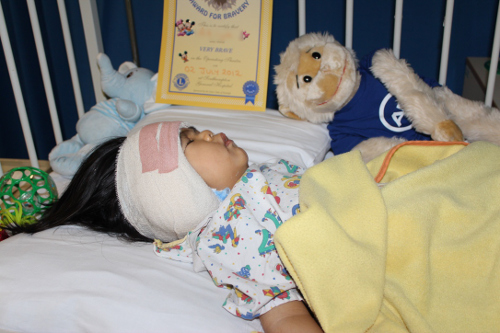
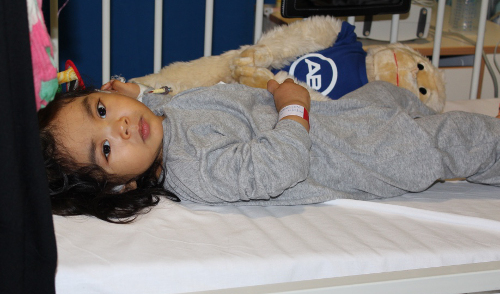
The night of July 2nd, 2012; a day we would not forget as long as we continue breathing! By that time we suspected that he was allergic to ibuprofen as he developed some rashes when he was given it previously. So the choices of pain killers available to him was limited and definitely whatever was given that night was not sufficient to suppress the pains he was having after the major operation on both sides of his head. He was clearly uncomfortable and crying almost the whole night; even though as per hospital rules only one parent was allowed to stay overnight, we both stayed and cuddling him all night in turns! Other than that the operation was a success and he was discharged on time. After a long wait for about a year we were excited to come to realise that our son was enjoying sound again and smiling on his favorite nursery rhymes!
In the early days feeding was not too much of a problem as he was able to suck well and was coordinating quite well too. As he got bigger and bigger he needed more milk then more puree food which was started when he was about 4 months all. Feedings were painstakingly slow, specially with puree food. During feedings he had to be distracted by another person playing his favorite nursery rhymes on a phone or iPad. Due to the effects to his motor functions, he struggled in coordinating to swallow food. While he was only fed with milk he would swallow more times than necessary, gulping air in the process. This frequently led to throwing up the milk he drank, more triggered by the air swallowed but not particularly due to reflux. This became more problematic since we started feeding him puree food. Some days he would through up every day or alternate days. We still wanted to feed him orally as we wanted to give him every opportunity to have his oral skills developed, hopefully leading to speech. Finally in Nov 2013 we had a videofluoroscopy test to analyse his swallowing pattern. Our son was always fed on his mum's lap, slowly on a certain position and he never wanted to be fed seated on a chair. The videofluoroscopy was done while he has seated on his pushchair and so he really resisted the feeding and this made the report particularly bed. In spite of the suspected aspiration we continued feeding him orally. Unfortunately our son had his first chest infection in May 2014 when he was 3.5 years old and then again in June 2014. After the first chest infection he was inserted a nasogastric tube and started feeding him through the tube. He finally had an operation to insert a Gastrostomy Tube (G-Tube) on 3rd July 2014.
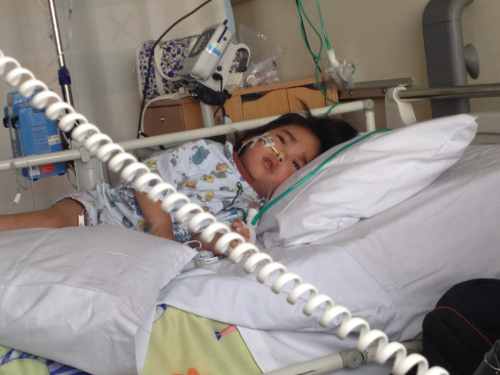
After this point he is orally given only little bits for taste. I wonder if any parent would happily eat anything tasty without thinking about their loving children especially the ones who happened to be disadvantaged or underprivileged! Whenever we eat something we feel bad to do so in front of him as he would also chew, perhaps expecting his share of the food!