“I was born normal with Apgar score 10/10 at 1 and 5 mins but my normal life lasted less than 5 days...”
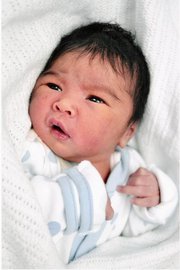
Sharing the story of our dearest son who became profoundly disabled as he didn't receive a simple treatment in time as a baby but always accepts the very many pains that he endures in his everyday life with big charming smiles, the smiles that give his parents the vital strength to keep going. We hope that these information serve to:
- Providing information to to-be parents
- Reminding the many health professionals the serious danger posed by Jaundice
- Sharing our experiences with those unfortunate parents out there
Chapters of Life
- Pregnancy - A period of dedication
- Birth - A special day for the parents
- Home - The moment of pride and jubilation for the family
- Hospital: Stage I - ICU, the moment the world turned upside down
- Hospital: Stage II - SCU, hope and prayer
- Home - A Second chance of life with a curtailed Splendour!
- Chief Executive's response, we just hope the hospital doesn't break any more hearts!
- What went wrong! - Parents please beware!
- Life! - Has to move on!
Hospital - Neonatal Special Care Unit
Lots have changed by then but we were happy to see him in the special care unit without all those machines connected to him anymore. We were able to connect with him more easily, holding and feeding him intimately. After the many tormented days and nights we started having some hope silently with continued prayers to god for thy mercy towards our son for he was as pure as thyself. We were doing as much as we possibly could by assisting and cooperating with the nurses in the special care unit wherever possible.
There were two main questions pending to be answered. What was the cause of the high bilirubin level? This was the question specially for the medical team who were looking for a clinical answer for the high bilirubin level. From the beginning, in every mornings' doctor round I kept saying with respect about my belief that the causes could be just untreated jaundice. Whatever blood/culture investigation reports for infection came back were negative. We were still waiting for some more results and my son was still on medication courses for suspected infections. This was definitely not the question in our mind, what in our mind was about the well being of our son, was he going to be all right? Some commented saying that he was still a baby and babies could heal easily! Yes he was still tiny but was very frail with abnormal movements, vocalisations and continuous fall of hairs!
On the morning of Dec 29th we had taken him for an MRI scan to find out if there had been any damage(s) done to his brain and if so to what extent. We heard about the report in the afternoon saying it was normal, meaning no damage done to our son's brain? No, it was not so clear cut, we were just in the unknown world. He was getting stronger and stronger, likewise our restlessness and anxiousness was getting stronger as well as the days went by due to the growing signs of abnormal body movements as well as the movements in his eyes.
In the next day or so a pediatric neurologist examined our son. I was closely standing by curiously awaiting to hear whatever she had to say. After the examination she gave us a guarded comment saying that she thought some damage had been done to his brain and she would be requesting for another report for the MRI scan. She continued saying that she still thought our son might be able to go to mainstream school! I just blankly looked up. The information did not come through to me as a shock as we already had feared for the worst. The question still remained was about the degree of the damage.
Another anxiety we had was about his hearing. We were not able to see responses to the types of sound we made, permissible within the hospital environment, by name (by then we used to call him 'Edu', literal meaning as 'remains of our blood'), etc. At the time he was on a hospital cot that got plastic/wooden barriers on all four sides. One day I was so anxious, I was standing by his cot and mildly tapping on one of the side barriers to evoke some response from him. A response did come! Unfortunately it was not from him but from the ward nurse who approached me and politely asking me not to tap!
My concern was confirmed when we had a hearing test on the 5th of Jan 2011. Both OAE and AABR tests failed on both the ears! He was referred to the audiology department to continue further testing after discharge from the hospital. The enormity of the monster we were confronting with was slowly getting revealed. The next question was his vision; I mentioned earlier, he started having strange eye movements (sun-setting) so was he able to really see us! He was referred to the ophthalmology department for investigation.
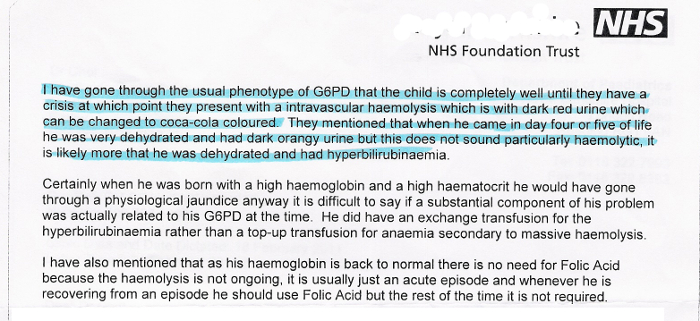
It was Jan 7th, the day our son was getting discharged from the hospital. The Consultant, who was in charge of the maternity ward where my son stayed when he was born, looked a relieved man in that morning's doctor round. His first comment was "We found the problem, the cause of the high jaundice level"! That day a test result from Kings College hospital said my son had low level of G6PD enzyme. The theory was that the G6PD deficiency could have induced a blood haemolysis resulting in the high jaundice, this was against what I had been thinking all along that the cause would be a cumulative effect of the untreated jaundice. So I innocently asked him if the issue could recur and how long the transfused blood would last, as the fundamental problem was still there. He said that it could last for about a month and we might have to do another blood transfusion in about a month's time!
The following is a report after a meeting with a Haematologist, according to her my son's presentation didn't show any sign of haemolysis induced by G6PD deficiency.
As per the information available over the Internet, there are around 400 Million G6PD deficient people worldwide (I'm sure most of them are unaware of it). It has a high prevalence in persons of African, Asian, and Mediterranean descent. The ratio is as high as 10.8% of population in Myanmar, 10.5% in India, 28.0% in Nigeria, 15.8% in Cambodia, etc. As per the Wikipedia page on G6PD deficiency, it is particularly frequent in the Kurdish population (1 in 2 males have the condition and the same rate of females are carriers). Individuals with G6PD deficiency can experience hemolytic anemia after ingesting fava beans or being exposed to certain infections or drugs. The Wikipedia page also says, on a positive note, that G6PD-deficient individuals do not appear to acquire any illnesses more frequently than other people, and may have less risk than other people for acquiring ischemic heart disease and cerebrovascular disease.
Why does G6PD deficiency happen more often in certain groups of people? As per kidshealth.org, it is known that Africa and the Mediterranean basin are high-risk areas for the infectious disease malaria. Researchers have found evidence that the parasite that causes this disease does not survive well in G6PD-deficient cells. So they believe that the deficiency may have developed as a protection against malaria. This should then be true for the high malaria zone of South West Asian region of North Eastern India, Myanmar, etc. So is it the case that G6PD deficiency was caused as part of the human evolution in the first place, that evolved a bit too much!